
PRACTICE AREAS

Practice areas for the injured and the wronged nationwide.

Tell us your story

FREE CASE REVIEW

Confidential. Reviewed by a member of the CBW intake team.

When negligence, misconduct, or corporate greed causes harm, you deserve a law firm that believes you, fights for you, and won’t back down in the pursuit of justice.

CBW is an Arizona-based law firm representing victims nationwide in Personal Injury, Mass Tort, and Employment Law claims. We fight for people who have been injured, exploited, or treated unfairly — pursuing accountability, justice, and the compensation you and your family deserve.

Claim reviews are always free, and there are no attorney’s fees unless we recover for you. Call us or simply tell us what happened through our confidential form.

Below are many of the claims we handle, but your situation doesn’t have to fit neatly into a category. If you believe you or your family have been wronged, tell us your story. We’ll listen and help you understand whether you may have a claim.

See who we represent ↓
Free Case Review
/ Getting help

It's as easy as 1, 2, 3.

Three steps. No cost to start, and no obligation if we are not the right fit.

  1. Step 1Reach Out

    Call us, or send your information through our confidential contact form.

  2. Step 2Talk to Us

    Take our call. We listen to your story, and we look at your case for free.

  3. Step 3We Fight for You

    If your claim qualifies, we take it on contingency — no money up front. We only get paid if we win your case. We fight for your rights, and for the money to help you climb out of the hole a corporation's negligence put you in.

You do the first step. We do the rest.

Tell Us Your Story →

Free claim review. No attorney’s fees unless we recover for you.

/ Overview

We stand between ordinary people and the companies, employers, and institutions that harmed them.

CBW was built for the person on the other side of somebody else’s decision — the driver hit by a fleet truck, the patient handed a device that was never tested in a human being, the worker who breathed something in for twenty years, the employee fired for saying out loud what everyone in the building already knew. None of them chose to be in a lawsuit. All of them ended up in one because a company, an employer, or an institution decided the risk was cheaper to carry than to fix.

That is the whole of our practice: standing between ordinary people and the organizations responsible for harming them. We take these cases on contingency, which means your interest and ours are the same interest — you pay nothing up front, and no attorney’s fee at all unless we recover for you. It also means we say no when a case is not there, and tell you why, because taking a claim we cannot win does you no favors.

Who we represent

Working people and their families, and almost never companies. Drivers and passengers, patients, tenants, students, seamen and railroaders, nurses and warehouse crews, survivors of assault, and the relatives left holding an estate that should not have been opened yet. If you were harmed and somebody else made the decision that harmed you, this firm was built for you.

How people are wronged

Negligence is the common one: a hazard somebody knew about and left alone. Misconduct comes next — an institution with the power to stop what was happening that chose not to look. Then there is corporate greed, which is negligence with a spreadsheet behind it: the recall delayed, the warning left off the label, the inspection deferred, the overtime never paid. Different names, one pattern underneath.

What we do about it

We listen first, for as long as it takes, and we tell you plainly whether you have a claim. If we take it, we take it on contingency — nothing up front, and no fee at all unless we recover for you. We build the record, retain the experts who can explain it, and put a number in front of the people who have to pay it. If they will not pay it, we try the case.

Accountability

The company, employer, or institution answers for the decision, on the record, in its own documents.

Fairness

The same lawyers and the same effort whether your claim is worth six figures or nine.

Compensation

Medical costs, lost income, the care you will still need years from now, and the harm that never comes with a receipt.

Answers

Most clients want to know what happened and why it was allowed to. Discovery is how we find out.

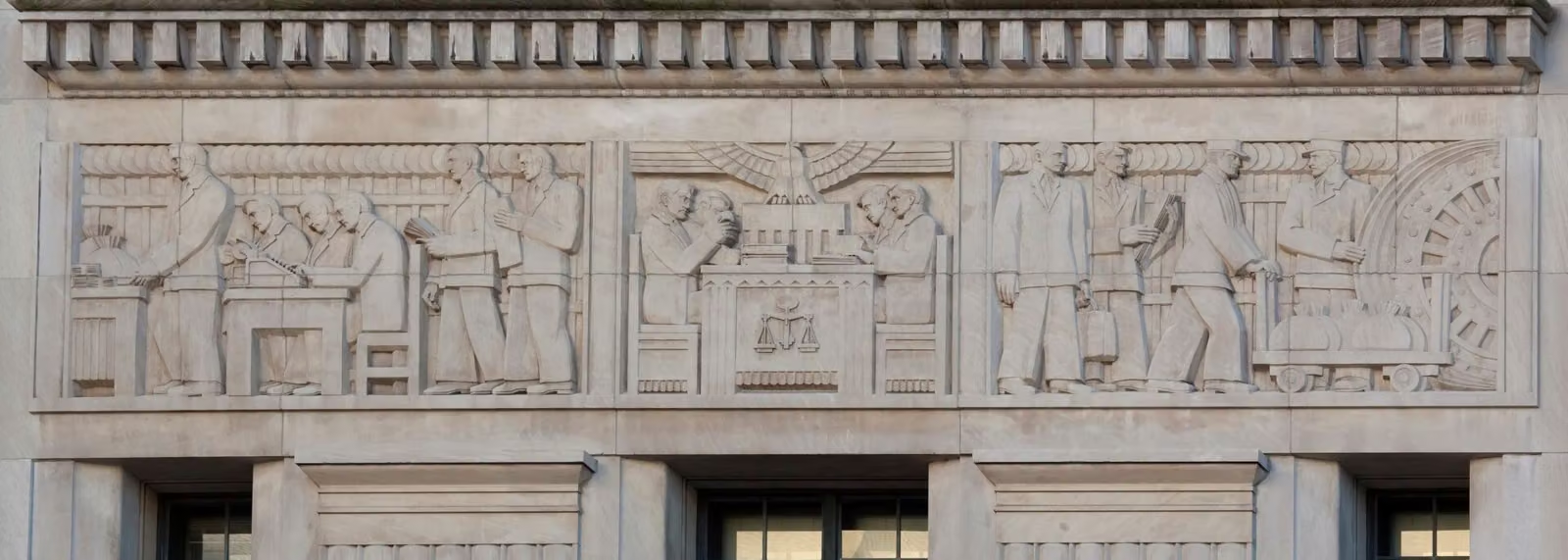
A carved limestone frieze above the entrance of a federal courthouse, showing people at work on either side of a set of scales.
/ Who we represent

How people come to us, and what we do about it.

Almost nobody arrives here knowing the name of their claim. People come to us with a fact, not a legal theory — a police report, a discharge summary, a termination letter, a diagnosis that landed thirty years after the job that caused it. Sorting that fact into a cause of action is our work, and it has never been the client’s job to know which heading below they belong under.

What follows is the whole of it: three practices, and under each one the claims we actually file. It is not a menu we hope to fill. Every area on this page is work this firm does, handled by lawyers who have taken these cases through discovery and put the people responsible under oath.

Read the area that sounds closest to what happened to you. The claim types under each heading are the language insurers, regulators, and courts use, and seeing your own situation named in that language is often the first moment any of it feels manageable. If two areas seem to fit at once, that is normal — one set of facts can support claims in more than one practice, and bringing them together is usually the stronger position.

And if nothing here quite matches, that is not a verdict on your case. This list is long, but it is not the boundary of what we handle; that boundary moves every time a manufacturer, an employer, or an institution finds a new way to cut a corner. Tell us what happened in your own words, and we will tell you plainly whether there is a claim in it. That conversation costs nothing and commits you to nothing.

A two-lane highway running straight through open Arizona desert, seen from the air.

Personal Injury

These are single-incident cases: a crash, a fall, a fire, an assault. The facts belong to you alone, but the insurer on the other side has handled thousands of them, and the first offer almost always arrives before anyone knows what the injury will cost over a lifetime. Our job is to build the record that makes a fair number the only defensible one.

When someone else’s carelessness hurts you, the bills start before the recovery does — ambulance, imaging, missed paychecks, a body that no longer works the way it used to. We handle the full range of negligence claims, from highway crashes to unsafe property to the deaths that leave a family to pick up the pieces.

Claims we handle

IVF & Fertility Treatment

IVF and fertility treatment ask patients to place extraordinary trust in doctors, embryologists, laboratories, and storage facilities. Treatment does not always work, and some complications happen even when everything is done right — an unsuccessful cycle is not, by itself, evidence of a mistake. But when an embryo is lost, genetic testing is wrong, reproductive material is mixed up, or a laboratory or treatment error causes harm, the consequences can be profound and sometimes irreversible. Our job is to find out what happened, preserve the evidence, and determine who should be held accountable.

Claims we handle

Embryo Genetic Testing (PGT)

Nothing here quite matching what happened to you? Tell us anyway. Most people are not sure what their claim is called, and that has never been the client's job to know.

Rows of identical amber sample vials in a laboratory tray, lit from one side.

Mass Tort

When the same product injures people the same way in every state, the case is not really about one patient. It is about what a company knew, when it knew it, and what it decided to say. We screen claims against the active federal and state coordinated dockets and pair every case we take with an experienced trial team we trust to pursue it effectively.

Product Liability

Defective Medical Devices

Dangerous Drugs & Pharmaceutical Liability

Every drug carries risk, and the company that sells it is required to tell you what that risk is. These cases are about what the manufacturer knew and chose not to say — the buried study, the missing label warning, the recall that came years too late.

Claims we handle

Mental Health & Behavioral Health Liability

Care for a mind in crisis carries a duty, and so do the products engineered to hold a young person’s attention. We bring claims against negligent psychiatric providers, abusive treatment programs, and platforms built to be hard to put down.

Claims we handle

Occupational Disease & Toxic Exposure

Some jobs make people sick slowly — dust, fumes, solvents, heat, noise. The diagnosis often lands decades after the exposure, long after the employer changed hands and the records went into storage. These cases are built from those records.

Claims we handle

Nothing here quite matching what happened to you? Tell us anyway. Most people are not sure what their claim is called, and that has never been the client's job to know.

A long production floor lined with work tables, staff working along its length.

Employment Law

An employer that knows you cannot afford to walk out can behave accordingly, and often does. These claims put the conduct on the record — the firing that punished protected activity, the harassment nobody in management wanted to hear about, the statute written for your trade, the hours that never made it onto a check.

Worker Injury & Occupational Protections

Seamen, railroad workers, longshoremen, and federal employees are covered by their own statutes — the Jones Act, FELA, the LHWCA, OSHA’s anti-retaliation rules. Used correctly, those laws reach further than ordinary workers’ compensation. Used incorrectly, a claim is worth a fraction of what it should be.

Claims we handle

Wrongful Termination & Employment Discrimination

Most people cannot afford to lose a job, which is exactly what makes an unlawful firing so effective. We bring claims for terminations that punish protected conduct, for discrimination and harassment a company chose not to fix, and for wages that never matched the hours actually worked.

Claims we handle

Nothing here quite matching what happened to you? Tell us anyway. Most people are not sure what their claim is called, and that has never been the client's job to know.

/ No cost, no obligation

Not sure where your case fits?

Describe what happened in your own words. We will tell you which of these areas your situation belongs in — or tell you plainly that you do not have a claim. Either way, the conversation is free.

/ Newsroom

From the CBW newsroom.

Two pieces from each of our three practices, written for people trying to work out whether what happened to them is a case. Every article is tagged to a practice, and the two most recent pieces in each practice are the ones shown here.

Personal Injury

Personal Injury: Appeals court leaves Boy Scouts bankruptcy plan in place, and the Supreme Court declines review

In May 2025, a federal appeals court let the Boy Scouts of America's bankruptcy plan stand. The plan created a trust to pay tens of thousands of sexual abuse claims. A group of survivors asked the U.S. Supreme Court to take the case, and in January 2026 the Court said no. Here is what the courts decided, and what they did not.

Read more about this Personal Injury article: “Appeals court leaves Boy Scouts bankruptcy plan in place, and the Supreme Court declines review”

Personal Injury: Revival laws for childhood sexual abuse claims: why state high courts have reached different answers

Many states have passed laws that let adult survivors bring childhood sexual abuse claims that had expired. Those laws have been challenged in court, often by the institutions being sued. Since 2023, the highest courts in Colorado, Louisiana and Maryland have reached different results. Here is what each court decided, based on the opinions themselves.

Read more about this Personal Injury article: “Revival laws for childhood sexual abuse claims: why state high courts have reached different answers”

Mass Tort

Mass Tort: The Federal Talcum Powder MDL: Where MDL No. 2738 Stands

Federal lawsuits alleging that Johnson & Johnson talc products contributed to ovarian cancer are gathered in one multidistrict litigation, MDL No. 2738, in the U.S. District Court for the District of New Jersey. As of the Judicial Panel on Multidistrict Litigation's September 1, 2026 report, 69,250 actions were pending in it, out of 71,935 filed over its history. Here is what an MDL is, who is overseeing this one, and how bankruptcy has affected it.

Read more about this Mass Tort article: “The Federal Talcum Powder MDL: Where MDL No. 2738 Stands”

Mass Tort: What IARC's Talc Classification Means, and How It Compares With FDA and NCI

In July 2024, the International Agency for Research on Cancer classified talc as "probably carcinogenic to humans," or Group 2A. The FDA and the National Cancer Institute describe the evidence on talc and ovarian cancer more cautiously. Here is what each body said, and why a hazard classification is not the same as proof of what caused one person's cancer.

Read more about this Mass Tort article: “What IARC's Talc Classification Means, and How It Compares With FDA and NCI”

Employment Law

Employment Law: Fired the week after the complaint

Retaliation is almost never announced. An employee reports harassment, files a safety concern, asks about unpaid overtime, or requests an accommodation, and within weeks the record around them changes. Performance reviews that were satisfactory for years turn critical. A policy that was never enforced is suddenly enforced against one person. A reorganization eliminates a single role. The stated reason is usually plausible on its face, which is the point. What makes these cases winnable is timing and comparison: how close the adverse action came to the protected complaint, and how the employer treated everyone else who did the same thing…

Read more about this Employment Law article: “Fired the week after the complaint”

Employment Law: The hours that never reached the paycheck

Wage theft in practice looks mundane. A shift is rounded down to the quarter hour, always in the same direction. Pre-shift setup and post-shift cleanup are treated as unpaid. A salaried title is applied to a job that is hourly work in every respect except the paperwork. A bonus that was earned is withheld because someone left before the payout date. Individually these amount to a few dollars a week, which is exactly why they persist — nobody sues over a rounding rule. Across a workforce and a few years, the same rule is worth a great deal to the…

Read more about this Employment Law article: “The hours that never reached the paycheck”

Editorial review

Reviewed by

Craig Weiss, founder and managing attorney of CBW Law Firm

Craig Weiss

Managing Attorney · CBW Law

View full profile →
/ Free case review

One call starts everything.

You will speak with someone from our intake team. If we cannot help, we will tell you who can.

Attorney advertising. The content of this website may be considered attorney advertising under the rules of certain jurisdictions. The information on this website is for general information purposes only and should not be taken as legal advice for any individual case or situation. Viewing this site does not create an attorney-client relationship. Prior results do not guarantee a similar outcome.